
By Dave Zeldon and Ely Schweyer
This is a question we hear daily during the spring, summer and, especially, the fall. Unfortunately, many homeowners do not see any adverse changes occurring in their trees until they look dead, or nearly so.
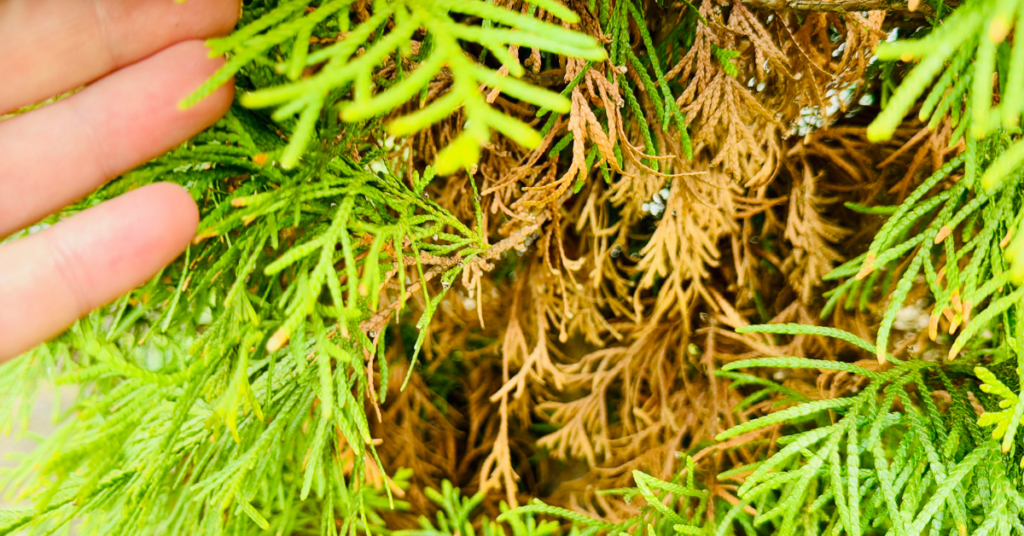
You Might Not Need to Panic Yet
The discolouration and dropping of evergreen needles are a natural phenomenon and the main cause of needle loss in the wild. Evergreen needles, as the name implies, survive for a lengthy period, and in fact usually have a life span of five to seven years on healthy trees, however, they must be shed. The needles first start to die in the central and lower part of the tree, and this change progresses upward over time. You will see spruce trees naturally lose needles as they get older.
Age is an important factor here in causing needle loss and branch death, however, in landscape plantings of coniferous evergreen trees, pests and disease are likely the major cause of needle loss and dying branches. If there is a sudden fall of a very large number of brown needles and leaves, this signals to us that there is something drastically wrong!
This can happen as early as a year or two after a tree is planted. This is especially true in Haldimand and Eastern Norfolk County where heavy clay soils predominate. Spruce trees, for example, do not grow well on clay soils.
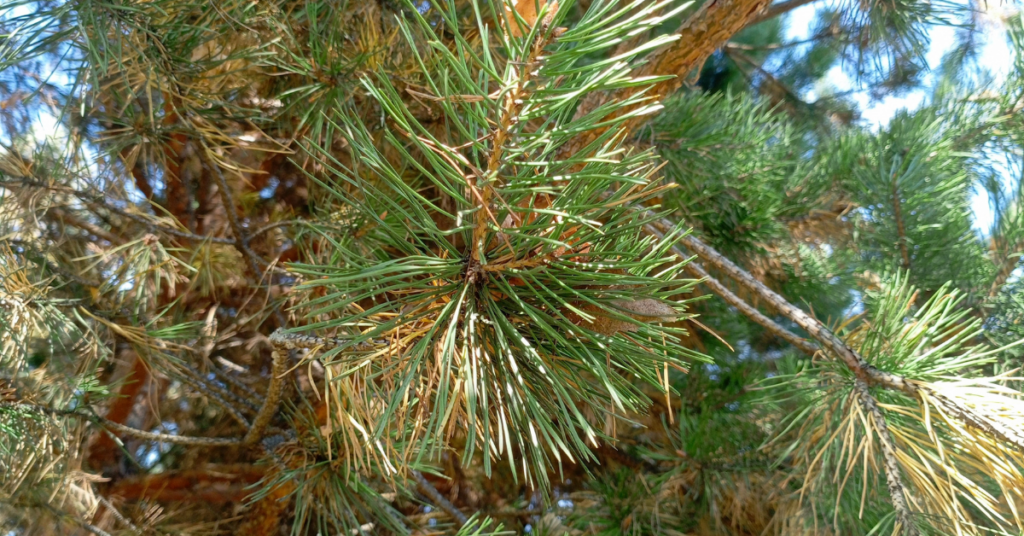
When You DO Need to Worry
Here are some of the more common problems, apart from natural aging that afflict spruce trees, the probable causes and ways of treating the problem.
☝️Unfortunately, these majestic trees, the most popular evergreen planted on our residential properties, incur many other pest and disease problems not dealt with here.
Symptom: Rusty brown needles that eventually fall.
Likely causes:
1. Internal fungus disease (called Cytospora or white blister canker). This creates cracks in the bark causing resin to drip and leave grey-white dripping streaks on the bark. The fungus also causes open wounds or blisters on tops of branches. These wounds can be greyish white or greyish blue in colour, eventually turning brown and black.
2. Feeding by spider mites which leave fine, poorly formed webs in the needles, especially near the ends of the twigs.
Best treatments:
1. Properly aerate and fertilize tree out to a distance of half its height in all directions, where possible.
2. Pressure wash thoroughly once a month with water only, all needles and branches as high as possible on the tree. Water pressure dislodges spider mites.
Symptom: Chewed up ends of twigs in June.
Likely cause:
Spruce bud worms which develop in the needle cluster that arises from a bud.
Best treatment:
Spray the biological pesticide, BTK (eg. Dipel), onto the entire tree when feeding is first noticed in early spring, to kill the young caterpillars.
Symptom: Black sooty mold covering twigs and needles.
Likely causes:
1. Spruce bud scales, ball-shaped insects, initially light brown in colour but eventually turning black. Often two to five scale balls cluster in one location on the twig; honey dew excretions from scales become infected with sooty mold.
2. An overhanging shade tree such as oak, maple or elm may have heavily infested leaves with aphids whose honey dew secretions become infected with sooty mold.
Best treatment:
1. Pressure wash tree using water only to dislodge young scales (called nymphs) in May and early June while they are in the crawling stage. Scale nymphs fall to the ground where they cease to be a threat to the tree.
2. Spray shade tree in early spring with insecticidal soap to control aphids. The problems of other coniferous evergreens such as pines, firs, cedars and junipers can usually be treated with correct diagnosis, though some diseases are lethal.
We hope these help you troubleshoot common issues often found in evergreen trees! For more information - and evergreens – visit Eising Greenhouse and Garden Centre! 🌲
Planting new trees into the landscape is always a worthwhile investment! Not only are they pretty to look at and provide cool shade on hot days, but they add a pretty significant increase in property value. Watching trees transition through each season is always a delight, but trees in autumn are especially beautiful. But did you know that autumn is actuaslly the perfect time to plant many of our favourite trees?
The root ball of a tree is quite sensitive. After all, it acts like their “brain” or central nervous system, so if you stress those roots out too much, you’re going to have a very tired looking tree on your hands. Here in Southern Ontario, if you plant in late spring or in the middle of summer, those high temperatures may be a bit too much for the roots to handle. The cool, mild temperatures of autumn are just right for transplanting.
6 Trees You Can Plant In Fall
Want to liven up your landscape with some colourful foliage? These ornamental trees for fall are so distinctly beautiful in their own different ways—it’s hard to pick just one!
Tulip Tree
This tree has so much style, and it grows surprisingly quickly, so if you’re a bit of an impatient gardener, you’ll love watching the tulip tree develop over the years. It gets its name from its gorgeous spring flowers, which you probably have guessed, look quite similar to the classic tulip! While it puts on quite a show in spring, it has a reputation for being especially beautiful in fall, when its sunny golden foliage turns a fiery orange shade.
Because the tulip tree grows so quickly, its branches tend to be a bit thin, so you may want to put it in a spot that gets some protection from the wind. Just make sure it gets at least some partial sun and isn’t too shaded, or else its leaves may turn brown. Regular pruning of your tulip tree and cleanup of any damaged branches will help keep things neat and help prevent pests from showing up.

Autumn Blaze Maple
There’s something so charming about a giant maple, and the blazing red leaves of this maple tree in autumn look so classically Canadian! It’s a perennial favourite, because it’s actually a cross between the red maple and the silver maple, and it seems to have taken on the best traits of both. Overall, it has stunning colours, a nice, balanced branching habit, and pretty sturdy limbs despite being a very fast grower.
Autumn blaze maples need full sun to grow to their best potential, but the condition of the soil is much less critical. This variety is actually quite drought tolerant and doesn’t mind poorer soils—just be sure you water it very regularly for those first couple of months after planting to help the roots establish.
Eastern Redbud
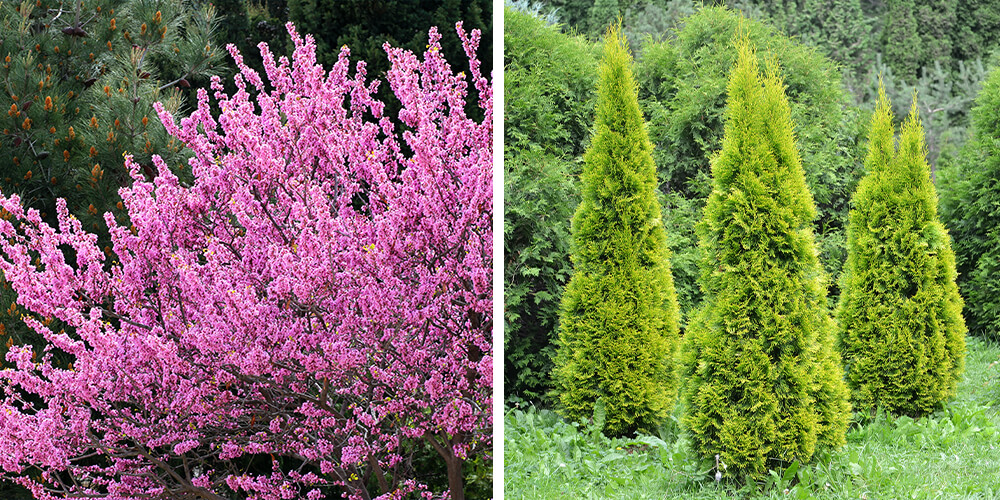
You’ll always look forward to spring in your yard with this show-stopping beauty around! It bursts into bright magenta blossoms and looks like it’s straight off the pages of a fairytale book. They don’t grow especially big—about 30 feet tall and wide at its largest—so if you’re looking for something a little smaller scale, the eastern redbud will suit the landscape nicely.
Ideally, you’ll want to plant your tree in a spot that gets direct sunlight in the morning, but a bit of shade in the afternoon, so a North or East-facing spot in the yard would work best. Plant it at least 8 feet away from any buildings to give it adequate room to spread, and try to put it in a spot that isn’t at the bottom of any slopes. This could cause too much moisture to collect near its roots, and this tree doesn’t like to sit in soggy soil. So long as the soil is quick-draining and isn’t piled up around the trunk of the tree, you aren’t likely to encounter any problems.
Emerald Cedar
We had to add a nice evergreen into the mix! Having vibrant foliage to admire year-round is always such a treat. This narrow variety is upright and handsome, reaching around 12 feet at maturity, so it’s super easy to integrate into the landscape and works particularly well as a hedge border. Its emerald green foliage is finely textured and lush all year long; it’s so classically refined!
This evergreen prefers full to partial sun. It likes well-drained soils, but isn’t very drought-tolerant and prefers moderate moisture, so if we go through a long stretch without rain, you’ll definitely want to water the roots with the hose to keep conditions comfortable. You aren’t likely to have too many pests issues with the emerald cedar, but in December, you may want to wrap it up with burlap to prevent the foliage from getting winter burn.
Heritage Birch
The bark of the birch tree is so uniquely beautiful and textured—we love the way it naturally peels off like paper, revealing fresh new bark underneath. The mature bark of the heritage birch almost has a pinkish tint to it, revealing creamy white new growth underneath. Growing up to around 70 feet tall and wide, it’s quite a sight to behold when grown with multiple trunks, instead of being trained into a single-trunked tree.
The heritage birch actually prefers its soil to be a bit more on the moist side and is more tolerant of clay soils compared to many other common landscape trees. It’s also quite heat tolerant, so as long as it gets some extra water, it shouldn’t be too fazed by a summer heatwave. If you’re going to prune your heritage birch, wait until fall to do so—in spring, the sap is a lot runnier and will make quite a mess!

Autumn Brilliance Serviceberry
This compact tree loves to show off its personality, covered with pretty white flowers every spring, and outdoing itself with orangey-red fall foliage. It produces berries from late spring and into summer, and it has smooth grayish-silver bark. It’s a nice small tree at just 25 feet maximum height. This is a great shade choice for small-scale landscapes. This serviceberry is suitable for planting under power lines.
Serviceberries grow best in full to part sun, and should not be allowed to dry out. This serviceberry is relatively low maintenance, and a beautiful addition to any yard.
Ready to plant some new trees at home? We’ve still got plenty in stock at Eising, and if you aren’t feeling super confident in your own tree-planting abilities, our experts are happy to provide landscaping services. Visit us in-store, or shop online to see our selection of trees that are ready for fall planting, and if you’d like to arrange for home delivery or curbside pickup, we can make that happen!