
By: Dave Zeldon and Ely Schweyer
Let’s get in depth about planting trees too deeply!
Sometimes homeowners find that their newly planted trees start showing signs of stress and become unthrifty a little while after planting, and soon their investment is altogether lost when the plant just dies. Often when we’re asked to inspect a tree in poor health, we know what to suspect.
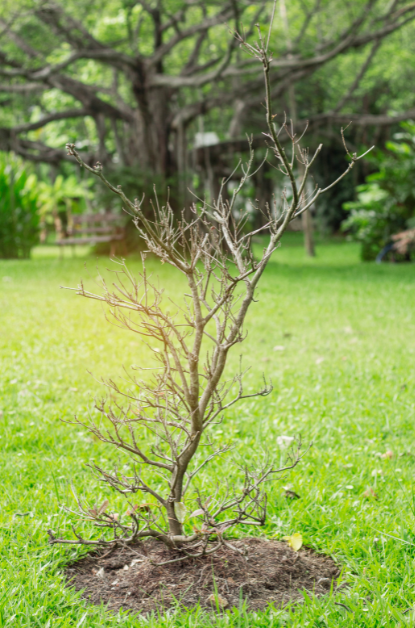
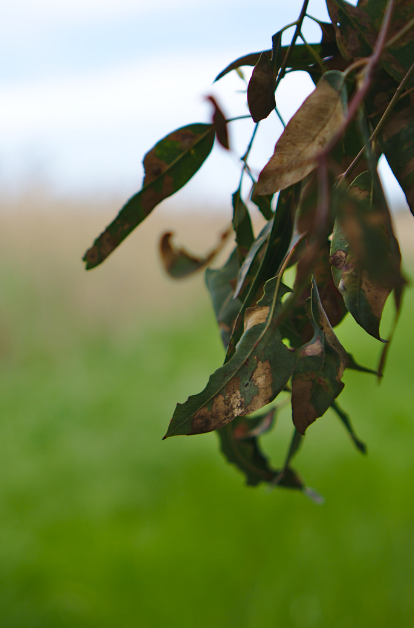
Although not readily apparent at the time of installation, the long-term effects of improperly placing the root system in the planting hole are substantial. The poor tree health that results manifests itself as reduced growth rate, atypical leaf size and colour, and increased disease susceptibility. Trees in really poor condition exhibit decay, cracks, and excessive deadwood. Sometimes trees show signs of stress within the first year of planting, but it usually takes several years for the problem to rear its ugly head.
The most common reason? Many trees are simply buried too deeply causing the tree roots to decline in health, as they cannot get the vital oxygen from the air that they require to live.
Putting Down Roots
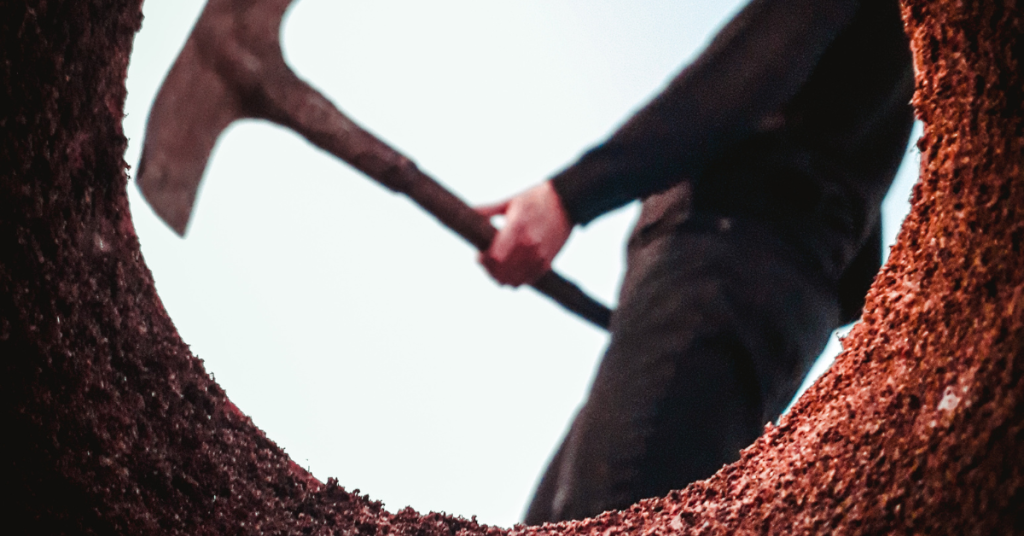
The width of the hole your tree will call home should be at least two times the diameter of the root ball, container, or in the case of bare root trees, the spread of the roots. This will provide the tree with enough worked earth for its root structure to establish itself.
For tree roots to grow vigorously, they require water, oxygen, and warmth. An oxygen level of 25% of the soil volume is considered good for root development.
At a 5% oxygen level, growth stops, and at 2%, roots decline and die.
Since tree roots naturally grow quite shallowly in the soil profile, buried root systems are unable to obtain adequate soil oxygen and water. As a survival response, trees work to get roots closer to the soil surface where there is a more reliable source of both. The energy that a newly transplanted tree should use to overcome normal transplant stress is instead used just to survive.
The tree expends its energy either by forcing its roots to grow upward or by creating totally new roots from dormant buds on the buried trunk, wasting all its prior growth. Some plants can survive being buried too deeply and live normal lives after developing a functional root system, others begin a long, slow decline of health resulting in either premature death or sudden failure during wind or ice storms. Let’s not risk it!
How Do I Know How Deep to Plant?
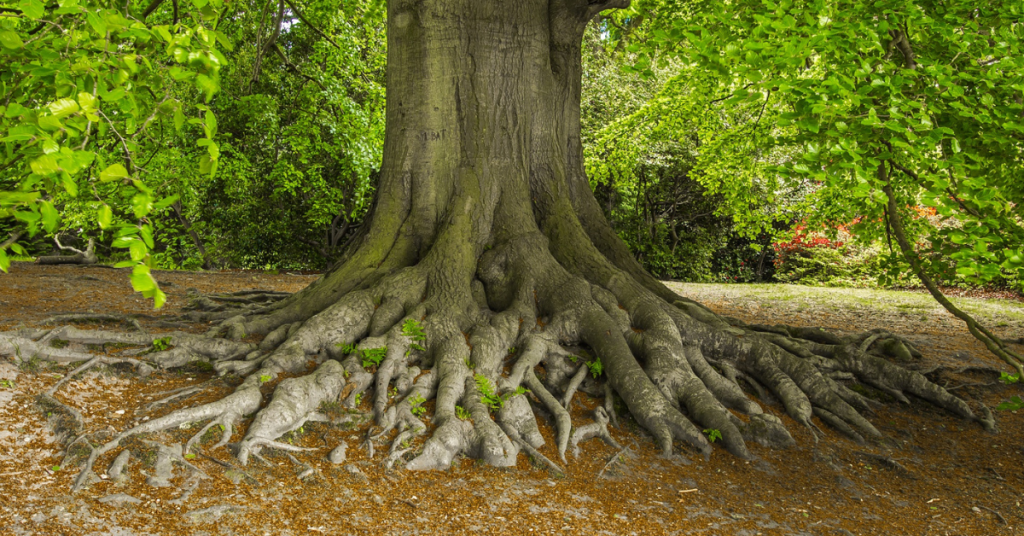
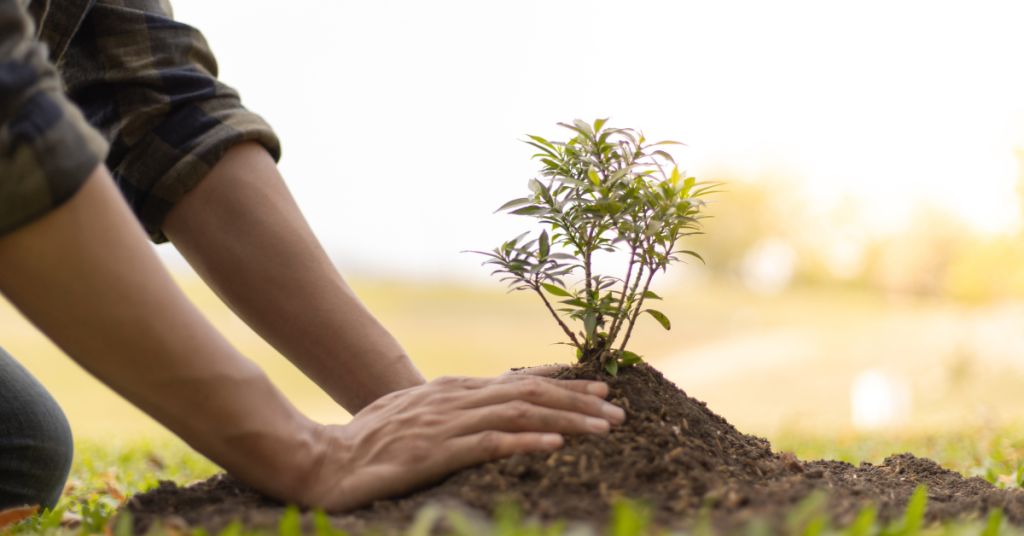
If you want your new tree to not only survive, but thrive, it needs the best start possible; it is very important that the root collar flare be visible after planting. The root collar is the part of a plant where the stem and root system meet, "flaring" where it transitions between the stem wood and the roots. Always make sure that the root collar flare is visible after planting. If settling occurs, reset the tree to the proper depth.
👉 Note: The backfilling soil should be a mixture of the original soil with composted manure or topsoil and bone meal.
But I Did Leave the Root Collar Visible… When I First Planted It
It has been observed that many times after a perfect tree planting, the homeowner then decides to build a raised-bed garden around the tree (thus burying the root collar flare – we’ve found root collar flares buried to 24 inches in mulch!) only to find that within a year or two, their young tree is dead or dying.
A common practice, often referred to as ‘volcano mulching,’ also contributes to this problem. In addition to subjecting trees to the problems associated with planting too deeply, heat from the composting mulch can literally cook a tree's trunk.
So, What is ‘Planting Proud’ Then?
The transplanting rules are amended if planting in the heavier clay soils where the practice of planting your new trees "proud" is advised. Planting proud essentially means that the root ball is left higher out of the ground level, producing a hilled effect. The soil that is normally used for back-filling is used to help to create a mound. Planting your trees this way in poorly draining clay soils prevents the ground water from collecting in an otherwise deep hole and drowning the roots of your new planting.
But, as a general rule, trees should be transplanted no deeper than the soil in which they were originally grown, and the soil level shouldn’t rise after planting. Two to three inches of wood chips is the optimum depth to mulch - and keep it an inch or two away from the trunk. If it is really desired to have the tree as a focal point in this newly built garden, then possibly a 3 foot well could be made around the tree to keep the root collar flare open to the air.
So, remember to give your tree a strong start and long life by not planting too deeply, but by leaving that root collar flare exposed! We hope these tips can help you encourage the longevity of your new tree. For more information - and trees - visit our Trees & Shrubs section at Eising Greenhouse and Garden Centre. We hope to see you soon!
Now that gardening season is in full swing, you're probably thinking about when and how to apply fertilizer—or perhaps you haven't thought about it at all! Here's an overview of everything you need to know to keep all your landscape plants looking lush and healthy from spring until frost.
Is Spring a Good Time to Fertilize?
Yes! Spring is when your plants begin their big growth spurt for the year, and they're going to need lots of nutrients to help fuel this growth—that's a fact! The nutrients found in fertilizers are essential for plants to perform their basic functions, and if there isn't enough in the soil, plant growth will be lacking. Fertilizing through spring, summer, and early fall will keep plants consistently nourished, but you won't want to apply anything after fall, as this will disrupt your plants' growth cycles when they need to go dormant over winter.
Understanding NPK Ratios
The three numbers on the fertilizer bag represent the ratio of the three primary chemical nutrients your plants need: Nitrogen (N), Phosphorus (P), and Potassium (K).

Nitrogen is necessary for the growth of healthy foliage. Phosphorus stimulates root growth and flower production, which in turn leads to fruit production. Potassium supports overall plant health and basic functions like nutrients and water uptake.
Not all formulas are the same, and many are for specific kinds of plants. You can use all-purpose fertilizers as a one-size-fits-all solution, as they have a balanced 10–10–10 NPK ratio, but using specially formulated products will yield the best results.
Since some plants have tons of foliage and no flowers, a high nitrogen formula is appropriate in those cases. However, if you give a high nitrogen formula with low phosphorus to a flowering plant, you'll get lots of leaves and barely any flowers; this is why it's essential to be choosy about which formula you use for your different plants.
What Fertilizers to Use in Spring
Here's a rundown of what needs to get fertilized in spring and the best types of formulas to use. Always follow the instructions on the package carefully! Over-fertilizing won't produce faster growth—it will just stress out your plants and make them grow faster than they should, resulting in weak, leggy growth. Over-fertilizing can also cause microbial imbalances in the soil, and too much synthetic phosphorus can contaminate groundwater, harming our aquatic ecology by causing algae blooms. Using an organic formula tends to be gentler on the soil, so you can seek an organic option if you'd like to play it safe.

Spring Lawn Fertilizer
Fertilizing in early spring with a "Weed and Feed" formula can help nourish your grass while preventing weeds from sprouting because it's mixed with a pre-emergent herbicide. However, it's too late to use a pre-emergent if it's already April or May. Instead, you can use a high nitrogen formula with a 3–1–2 or 4–1–2 NPK ratio. If you have a big lawn, you can use a broadcast spreader to make the application easy and even across the landscape.
Shrub and Tree Fertilizer
Formulas with an NPK ratio of 16-4-8, 12-4-8, or 12-6-6 are usually appropriate for trees and shrubs. However, there are many formulas available for certain types of trees and shrubs, such as:
- Azaleas and rhododendrons
- Citrus fruit trees
- Roses
Spread the fertilizer at a diameter equivalent to 1.5X the size of the crown. Remember to follow the package instructions to calculate how much to apply at one time! Try your best to avoid getting any granules on your shrub's foliage, as this can burn the leaves.

Perennial and Annual Fertilizer
Balanced all-purpose formulas are usually fine for your perennials and annuals, but you can also use something with slightly higher phosphorus to encourage more blooms. Just remember not to overdo it with the phosphorus! Granulated slow-release formulas will deliver a steady stream of nutrients to your flowers over a month or so, but if you want to give your plants an instant boost in spring, you can use a water-soluble formula that will go straight into the soil.

Vegetable Fertilizer
Use a formula that is safe for use on edible plants. If you want to grow an organic vegetable garden, then stick to using an organic fertilizer!
Eising Garden Centre has plenty of spring fertilizer for sale for all your plants, outdoors and indoors! Visit us soon—spring is almost over, and your plants need a boost so they can keep growing steadily throughout the rest of the year!