
By: Dave Zeldon and Ely Schweyer
Let’s get in depth about planting trees too deeply!
Sometimes homeowners find that their newly planted trees start showing signs of stress and become unthrifty a little while after planting, and soon their investment is altogether lost when the plant just dies. Often when we’re asked to inspect a tree in poor health, we know what to suspect.
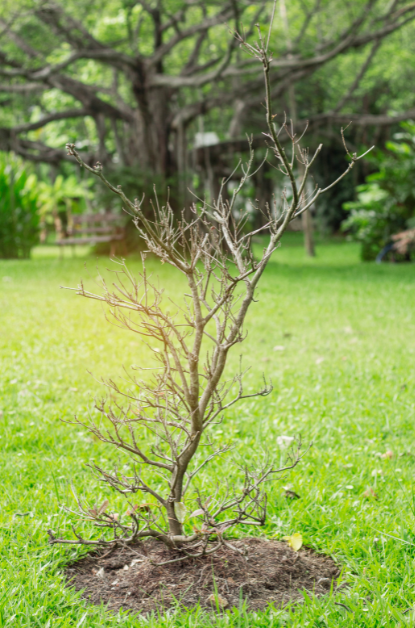
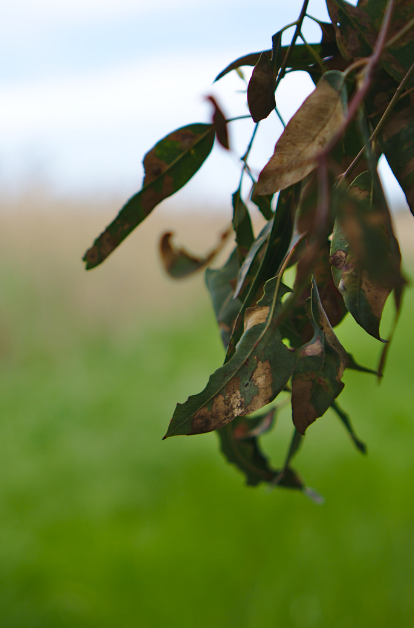
Although not readily apparent at the time of installation, the long-term effects of improperly placing the root system in the planting hole are substantial. The poor tree health that results manifests itself as reduced growth rate, atypical leaf size and colour, and increased disease susceptibility. Trees in really poor condition exhibit decay, cracks, and excessive deadwood. Sometimes trees show signs of stress within the first year of planting, but it usually takes several years for the problem to rear its ugly head.
The most common reason? Many trees are simply buried too deeply causing the tree roots to decline in health, as they cannot get the vital oxygen from the air that they require to live.
Putting Down Roots
The width of the hole your tree will call home should be at least two times the diameter of the root ball, container, or in the case of bare root trees, the spread of the roots. This will provide the tree with enough worked earth for its root structure to establish itself.
For tree roots to grow vigorously, they require water, oxygen, and warmth. An oxygen level of 25% of the soil volume is considered good for root development.
At a 5% oxygen level, growth stops, and at 2%, roots decline and die.
Since tree roots naturally grow quite shallowly in the soil profile, buried root systems are unable to obtain adequate soil oxygen and water. As a survival response, trees work to get roots closer to the soil surface where there is a more reliable source of both. The energy that a newly transplanted tree should use to overcome normal transplant stress is instead used just to survive.
The tree expends its energy either by forcing its roots to grow upward or by creating totally new roots from dormant buds on the buried trunk, wasting all its prior growth. Some plants can survive being buried too deeply and live normal lives after developing a functional root system, others begin a long, slow decline of health resulting in either premature death or sudden failure during wind or ice storms. Let’s not risk it!
How Do I Know How Deep to Plant?
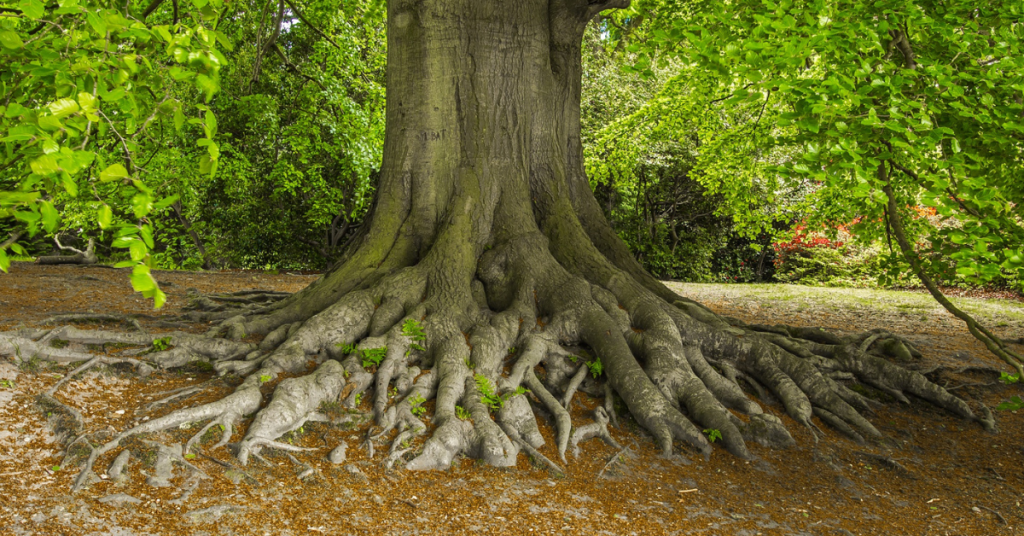
If you want your new tree to not only survive, but thrive, it needs the best start possible; it is very important that the root collar flare be visible after planting. The root collar is the part of a plant where the stem and root system meet, "flaring" where it transitions between the stem wood and the roots. Always make sure that the root collar flare is visible after planting. If settling occurs, reset the tree to the proper depth.
👉 Note: The backfilling soil should be a mixture of the original soil with composted manure or topsoil and bone meal.
But I Did Leave the Root Collar Visible… When I First Planted It
It has been observed that many times after a perfect tree planting, the homeowner then decides to build a raised-bed garden around the tree (thus burying the root collar flare – we’ve found root collar flares buried to 24 inches in mulch!) only to find that within a year or two, their young tree is dead or dying.
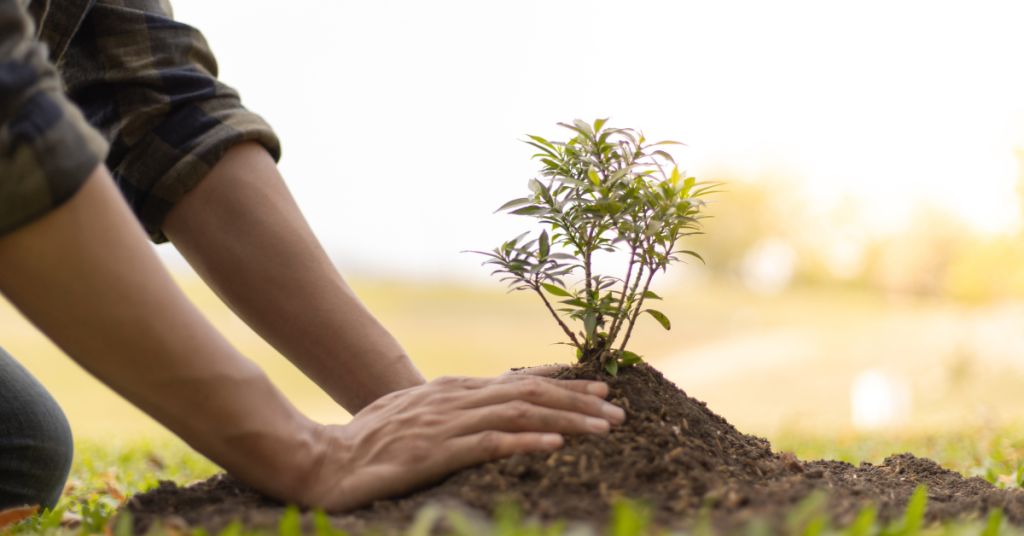
A common practice, often referred to as ‘volcano mulching,’ also contributes to this problem. In addition to subjecting trees to the problems associated with planting too deeply, heat from the composting mulch can literally cook a tree's trunk.
So, What is ‘Planting Proud’ Then?
The transplanting rules are amended if planting in the heavier clay soils where the practice of planting your new trees "proud" is advised. Planting proud essentially means that the root ball is left higher out of the ground level, producing a hilled effect. The soil that is normally used for back-filling is used to help to create a mound. Planting your trees this way in poorly draining clay soils prevents the ground water from collecting in an otherwise deep hole and drowning the roots of your new planting.
But, as a general rule, trees should be transplanted no deeper than the soil in which they were originally grown, and the soil level shouldn’t rise after planting. Two to three inches of wood chips is the optimum depth to mulch - and keep it an inch or two away from the trunk. If it is really desired to have the tree as a focal point in this newly built garden, then possibly a 3 foot well could be made around the tree to keep the root collar flare open to the air.
So, remember to give your tree a strong start and long life by not planting too deeply, but by leaving that root collar flare exposed! We hope these tips can help you encourage the longevity of your new tree. For more information - and trees - visit our Trees & Shrubs section at Eising Greenhouse and Garden Centre. We hope to see you soon!
Here in Simcoe, we’re far enough South to enjoy a wide variety of flowers and plants in our garden, including many that hail from tropical rainforests and other exotic locations. However, not all tropicals can withstand our unpredictable Canadian weather, and providing a plant with similar conditions to a rainforest can prove to be tricky. To save the guesswork of whether or not your new, exotic plants will thrive, as well as a ton of time and effort in the long run, we recommend filling your garden with Ontario native plants.
Ontario native plants are so well adapted to our climate, they’re basically able to care for themselves, which is why they grow naturally in the wild. Many are perennials, so you can continue to enjoy them year after year if you plant them in your garden. A little maintenance here and there to keep things neat and trim, and some occasional watering during dry periods is pretty much the bulk of the effort you’ll have to put in with Ontario native plants.
On top of being easy to care for, Ontario native plants are favoured among pollinators like bees, butterflies and hummingbirds. Simcoe wildlife is attracted to the familiarity of Ontario wildflowers, and they usually have much more pollen than specialty hybrid plant varieties.
The Best Ontario Native Plants for Simcoe Gardeners
There seems to be an assumption that your garden needs plenty of exotic tropicals in order to really impress, but that couldn’t be further from the truth! We’ve compiled a list of some of the most beautiful Ontario native plants to add to your landscape, so you can have a picturesque yard (with extra butterflies!) for way less effort:
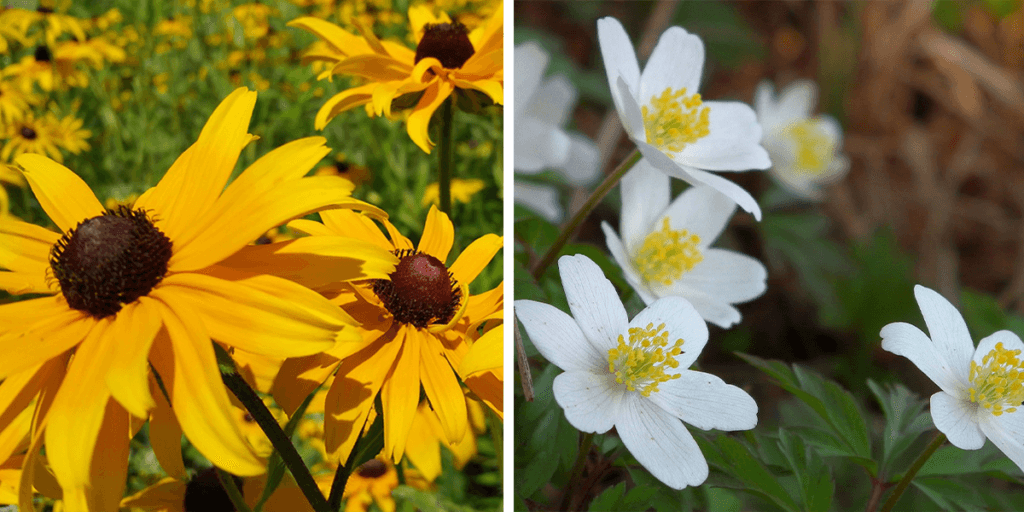
Black Eyed Susan: The sunny golden petals or this Ontario native wildflower will instantly brighten up your garden and fill it with butterflies and birds who love to sip its nectar. Black Eyed Susans flower from June to September, so they’re great to mix in with spring-blooming Ontario native plants to ensure your garden is colorful for the entire patio season.
Canada Anemone: Little, white, cup-shaped flowers with butter yellow centres sit atop vivid emerald foliage on this popular Ontario native plant. It spreads easily, is highly drought-tolerant, and grows well in either sun or shade, making it a fabulous filler plant for those hard-to-reach spots in the garden.

Bee Balm: These Ontario native shrubs are covered in the wackiest looking blossoms that kind of look like a haircut Cyndi Lauper had in the ‘80s. It isn’t just bees that love them— butterflies and hummingbirds are big fans too. When planting bee balm in your garden, it’s best not to crowd it too much and give it a little room to breathe so it doesn’t develop mildew on its leaves.
Butterfly Weed: As you can probably guess by the name, these native shrubs of Ontario are covered in flowers that butterflies just can’t resist. The vibrant orange petals attract a certain butterfly of similar styling: the elusive Monarch, whose orange, white and black markings are always a delight to behold.
Purple Coneflower: Also known as Echinacea, these gorgeous daisy-like blooms are a favourite among bees because their bulbous pollen-filled centres are very easy to perch on. If the soil quality in your yard isn’t fantastic, this flower is a great option, because it actually thrives in not-so-great soil conditions. You’ll get way more blooms this way because soil filled with amendments and fertilizers will cause it to develop more foliage than flowers.
Blue False Indigo: These Ontario native plants are part of the pea family, so their blossoms look like those you’d see on your typical pea shoot, but instead are a stunning purple-blue jewel tone. If you don’t deadhead the spent blossoms, they’ll start to develop little peapods. Some gardeners like the appearance and rattling sound the peapods make in the wind, so you can choose whether you want to leave them on or off.

Wild Strawberry: Who doesn’t love a low-maintenance garden plant that provides you with tasty snacks? One cup of these tiny fruits is packed with more vitamin C than an orange, and they develop from the centres of cute five-petaled white blossoms.
Cardinal Flower: This bold blossom is an all-time favourite among hummingbirds. They’re particularly attracted to the candy apple red colour of the petals that cover tall, upright stems that stand out from the surrounding dark green foliage. They can grow up to 4 feet tall, so they make quite a statement as a border plant or an eye-catching focal point for the centre of your garden.
If you long for a vibrant garden full of all sorts of different plants, but don’t have a ton of spare time to devote to regular maintenance, consider planting a garden full of Ontario native plants! You’ll love the color and fragrance they bring to your garden—and the local wildlife will enjoy it too!